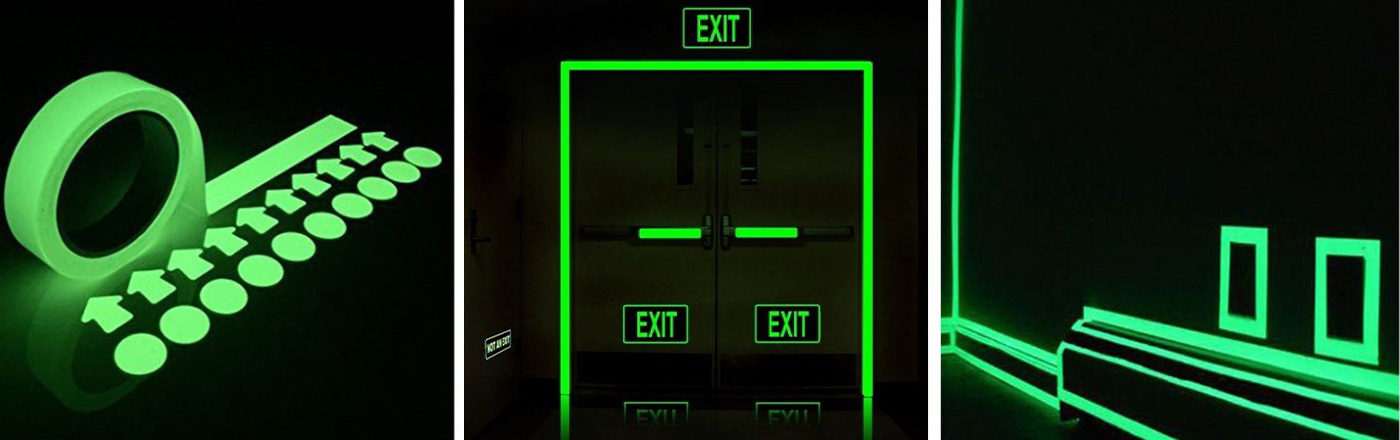
LUMINESCENT FILM
Luminescent film is a material that has the property of absorbing light naturally and then giving it out very well. Luminescent film is 1.24cm x 45.7 m long acrylic film and is suitable for printing.
It is used in fire extinguishing tools and equipment, warning signs, trains, trams, road signs, information boards on the door, and in all areas as decoration.

| Luminescent Foil | |
| Foil Type | VF-10-11 / PET VF-10-31 / PET + PVC |
| Feature | VF-10-11 / PET : Excellent results in lettering and cutting. VF-10-31 / PET + PVC : It gives excellent results in screen printing and inkjet printing. |
| Color | Green |
| Thickness | VF-10-11 / PET : 200 – 210μ VF-10-31 / PET + PVC : 220 – 230μ |
| Craft Paper | 120 g/m² |
| Roll Size | 1.24 x 45.7m |
| Light Reflection Time | 2-4 Hours |
| Application Temperature | 18˚C – 28˚C |
| Durability | 3 Years |
What’s luminescent film?
It is a light-reflecting material and is generally used for light reflection and light directing purposes. Its characteristics may vary from product to product, but generally have the following characteristics:
- High reflectivity: It is characterized by its high reflectivity of light. Thanks to this feature, it directs the light to the targeted area and provides a brighter light.
- Flexible and bendable: It is generally flexible and bendable, which makes it easier to use.
- Durable: It is made of high-quality materials and is durable. It is long-lasting because it is resistant to scratches and other damage.
- Various thicknesses: Available in different thicknesses. The thickness can affect the durability and light reflecting capacity of the film.
- Self-adhesive: Some types are self-adhesive and can be easily adhered to the surface.
The advantages may differ according to the intended use. For example, films used for stages and events may have higher light reflectivity and may be presented in larger sizes.
Since luminescent film is a reflective material, it has many different uses. Here are some areas where it can be used:
- Stage and events: It is an ideal material to be used in stage lighting and events. It provides a brighter light by reflecting the light of the stage lights.
- Billboards: It is a material used in billboards. Thanks to the reflection of light, it makes the writings on the boards clearer and more visible.
- Car wraps: Some car wrap films may contain luminescent film. It is applied to the outer surfaces of the cars, providing better visibility at night.
- Lighting products: It can also be used in lighting products. For example, lamps or led strips covered with luminescent film give a brighter light.
- Decoration: It can also be used in the decoration field. It can be used for decorative purposes, especially in parties or celebrations.
- Security products: It can also be used in some security products. For example, it can be used on products with a reflective surface, such as signs or reflective clothing.
Its usages are quite diverse and this material is used in many sectors that need light reflection and direction.
Its application may vary according to the process to be performed and the surface to be used. Below are the general steps for luminescent film application:
- Surface preparation: The surface to be applied must be clean, dry and smooth. The surface should be free of dust, oil, dirt or moisture.
- Film cutting: It should be cut according to the application surface. While the film is being cut, it may be better to cut a little extra and clean up the cut marks afterwards.
- Film bonding: It is placed on the surface to be applied with its adhesive surface. The bonding process should be done carefully and slowly so that the film does not lose its stickiness.
- Film correction: While applying, bubbles or wrinkles may form on the film surface. In this case, the film can be smoothed gently using a spatula or similar tool to smooth the surface.
- Film cutting: The excess parts of the film are cut after the application. Cutting can be done using a sharp knife or scissors.
- Film fixing: It should be well fixed on the applied surface. After the bonding process is completed, additional supports such as tape or adhesive tape can be used on the film edges.
The application process should be done carefully and slowly. Errors that may occur on the film surface may be difficult to correct later. Therefore, careful planning is recommended before the application process.